A GRIEF GROUP FOR WOMEN
Honoring
Loss
Finding clarity in the stillness.

If you're reading this, something in you is already ready to put it
down. Six weeks. One small group. The real work — for women
who are done performing okay.
BEGINS JUNE 10TH · SIX WEEKS · A SMALL GROUP
WHAT YOU'LL WALK AWAY WITH
After six weeks, you'll
know how to carry it.
Imagine six weeks from now — same coffee, same morning — and the weight in
your chest sits differently. Not gone. Your grief won't disappear; it shouldn't.
It's the measure of what you loved. But you'll leave with something you didn't
have walking in.
i.
A letter you wrote and read aloud — to whoever or whatever you lost.
ii.
A journal full of practices and prompts that are yours to keep.
iii.
A small group of women who witnessed your grief — and were witnessed in theirs.
iv.
Rituals you'll use for anniversaries, hard days, and grief bursts years from now.
And a different relationship with what happened. Not a smaller loss. Not a forgotten one.
A loss you know how to carry — with meaning, with peace, with
the relationship intact.
WHY THIS GROUP EXISTS
Grief is what you feel after
the trauma is over.
Grief is exhausting. Talking about it with people who don't quite get it is worse. And you've probably been pushing through, mostly alone. That's why this group exists.
We were taught to be strong. To stay busy. To give it time. To not make anyone uncomfortable with how much we were still carrying. So we performed — and started to believe our own performance.
But the grief didn't go anywhere. It moved in. It shaped how we sleep, how we love, how we work, how we hold ourselves in rooms we used to feel safe in.
Grief responds to specific work — and most of us were never taught any. As you read this, you may already be noticing what's been waiting.
A NOTE ON LOSSES
Bring whatever loss you
have. Every one of them counts.
Years ago I went to a week-long grief intensive. They asked us to map every loss across our lives — deaths, moves, versions of ourselves we'd had to leave behind.
The loss I broke down on was not one of the big ones — not my mother, not my father, not a sibling. It was my cat, Abercrombie. It may not have been the "biggest," but it was the one my body could finally let through.
Sometimes the small loss is the one that finally lets the big one move.
His death wasn't bigger than my mother's or my father's. It was just the door my system could finally open. Everything else had been waiting there for years.
Every loss matters. The body doesn't grade on a curve. Whatever you're carrying is real, and it's workable.
You don't need to justify what you're grieving. Bring it.
WHO THIS IS FOR
If something is still
unfinished in you, you
belong here.
FOR WOMEN GRIEVING
— The death of someone you loved
— Miscarriage or pregnancy loss
— A relationship that ended
— A parent who couldn't show up
— A pet who was family
— Estrangement, divorce, betrayal
AND LOSSES LESS OFTEN NAMED
— A job, role, or identity
— The version of yourself before
— Safety after trauma
— A body or health you trusted
—The life you thought you'd have
—Anything still unfinished in you
Whether you join this cohort or the next, something in you is already doing the work. Bring whatever you're carrying.
SIX WEEKS, SIX PIECES OF WORK
Name it. Process it.
Make meaning of it.
i
Grief Reframed
Clear away what you've been told. Replace it with something true.
ii
Mapping Your Story
Surface every loss across your life. Choose the one we'll work with.
iii
Inside the Relationship
The real version. Not the eulogy
version.
iv
What's in the Way
Soften the beliefs that have kept the grief stuck.
v
Composing the Letter
Draft your Completion Letter. Apologies, forgiveness if true, pain, love.
iii
Reading & Carrying Forward
Read it. Be witnessed. Walk forward differently.

IN THEIR WORDS
"I came in carrying something I couldn't name. By week six I had written the letter I'd been avoiding for nine years. I read it aloud. I'm still carrying the loss — but I'm not carrying it the same way."
— RACHELE M.
I'd done years of therapy and still felt stuck. Six weeks here did something different — I stopped performing okay and started actually feeling it. I finally have somewhere to put it down."
— SHIRA C.
WHAT'S INCLUDED
Six weeks. Everything you
need.
THE WORK
Six 90-minute sessions
Six weekly group sessions, plus your Completion Letter — drafted and read. A companion journal with every practice and prompt.
THE SUPPORT
Held start to finish
A 30-minute welcome call before week one, a 30-minute integration call after week six, and between-session support throughout.
THE GROUP
Women doing the work
A small group of women working alongside you. Virtual, confidential, witnessed — with rituals you take with you.
DETAILS & INVESTMENT
Your founding cohort
begins June 9th, 2026.
DATES
Jun 9 – Jul 14
Six Wednesdays
SCHEDULE
Tuesdays
5:00–6:30 PM ET
FORMAT
Virtual
via Zoom
INVESTMENT
$297
Founding rate
Cohorts are kept to a small group on purpose — so your story actually has room to land. Founding rate won't be offered again.

Tanya Freeman — your guide for these six weeks.
WHO'S LEADING THIS GROUP
Tanya Freeman, LMSW
Licensed therapist & trauma-informed grief practitioner
I lost both parents young, along with much else. I stayed strong and kept going. My system couldn't hold it.
Grief compounds grief. Loss compounds loss. Without the work to integrate them, they simply stack.
I built this group from what I learned getting myself back together — and from years of doing this work with women since.
I eventually got the help I needed: a week-long intensive, years of therapy, and training in the methods that actually move grief instead of suppress it. Everything here is held with that same trauma-informed care. It's the program I wish had existed when I needed it.
LICENSED THERAPIST
IFS TRAINED
TRAINED — SOMATIC EXPERIENCING
TRAUMA-INFORMED CARE
TRAINED — GRIEF RECOVERY METHOD
EMDR-CERTIFIED
10 YEARS CLINICAL GRIEF WORK
COMMON QUESTIONS
What you might be
wondering.
Time doesn't heal grief — completion does. If something's still alive in you, it's still workable, even decades later.
Probably not yet. The first weeks of acute grief need different support. Apply for a future cohort once you're past the acute phase.
Read the cat story above. The body doesn't grade on a curve. Every loss in this group is real.
No. I'm a licensed therapist and the work is deeply informed by that training, but the group is offered as grief coaching and support — open to women regardless of where they live. It can produce real change, but it isn't a substitute for therapy if you have a clinical mental health condition.
Six weeks isn't long enough to finish grieving. It's long enough to do the specific work that changes how you carry it. The grief stays. How you hold it changes.
READY TO BEGIN
When you join, you'll know where to put it down.
Some women find themselves saying yes before they
finish reading. A short 5–7 minute note is the first
small step — I read every word.
Founding cohort begins June 2nd, 2026 · Eight women, on purpose.
A FREE GIFT — NOT READY TO APPLY?
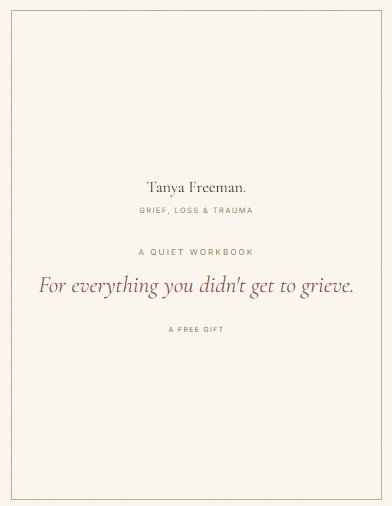
For everything you didn't get to grieve.
A short companion for the losses that didn't get to be losses.
A quiet workbook for the grief that never got a name — the miscarriage no one mentioned, the pet who was family, the life that never arrived. Gentle prompts, a small ritual, and room to finally call it what it was. If you're not ready to apply, this is where to begin.
You'll also receive occasional notes from me on grief and loss. Unsubscribe anytime.
Honoring Loss
© 2026 TANYA FREEMAN · ALL RIGHTS RESERVED